
After last week’s deep dive into posture and power on the bike, this week we’re turning our attention to another key piece of the triathlon puzzle: running. Specifically, how the strength and control developed in the gym can help keep me running strong, smooth and injury-free, especially when fatigue sets in.
One of the biggest issues I’ve faced during heavy run blocks (and on tired legs mid-race) is compression through my lower back and sacral area. It’s not a sharp pain, more of a grinding tightness that creeps in when my form starts to fade and I stop engaging the right muscle groups. This week, Lisa and I worked on that, and more importantly, on why it’s happening.
Where strength meets movement
The goal was simple: apply the activation and control work we’ve done in the gym to real running mechanics. That meant taking things back to basics, stripping away the speed and impact, and focusing on how the body should move, and what needs to fire to support that movement.
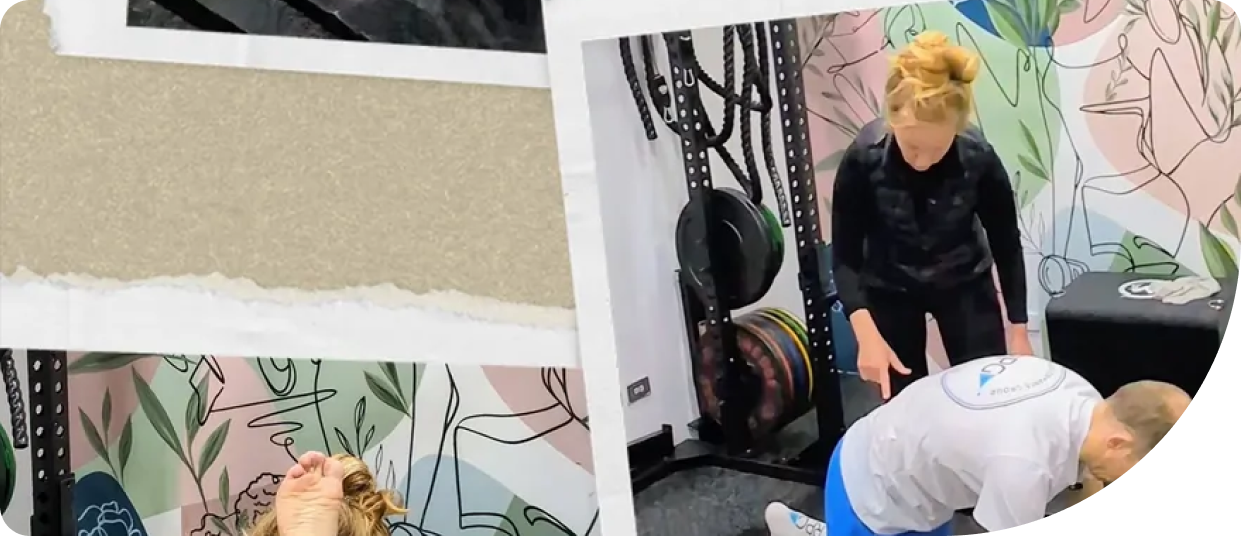
We started with a quadruped setup (hands under shoulders, knees under hips) and did a few gentle cat-cows to find a neutral spine. From there, we focused on breathing into the lower abdomen, switching on the deep core and building intra-abdominal pressure, not in a “brace and clench” kind of way, but through solid, intentional breathing and activation.
Then things got spicy: From bear to brilliance
Lisa had me lift my knees slightly into a low bear hold. Just a few centimetres — but enough to light up my core and demand real control. From there, we progressed into a “high bear” position and added a dynamic movement: lifting one leg slowly into hip extension, then returning with control.
The challenge? Keep everything else still. No wobbles through the hips, no arching in the back, no twisting. Just clean, stable movement from the hip joint, with the trunk acting as a strong, quiet foundation.
This is what real running should feel like. Not slumped, sagging or collapsed through the middle, but tall, strong and connected — with each step driven from the right place.
Why this matters
When I’m running hard, tired or uphill, it’s easy for the form to unravel. The core switches off, the lumbar spine overworks, and suddenly you’re fighting yourself rather than flowing forward.
By building this kind of control, and practising it regularly, I’m training my body to move better when it counts. Not by thinking about form mid-run (no one has time for that in a race), but by making good movement patterns second nature.
As Lisa said, “this kind of connection doesn’t happen by accident.” It’s trained. Practised. Repeated. And if I want to run well in three races over five days in Wollongong this October, this stuff matters more than ever.
Huge thanks again to Lisa and the whole Wellness on Shore crew for helping me stay on track, and for keeping me honest when things get tough in the gym!
📽 Want to see what we did in action? Check out the full video here:
👉 https://youtu.be/2iZKyq-pF0k
More to come; this journey is all about better habits, one session at a time.